


Early Life
Nick got into computers long before he had one of his own. His first exposure was an Acorn at his junior school in the countryside — hardly cutting-edge, but it was enough. He wasn’t just playing around on it; he wanted to understand how it worked. He eventually wore his parents down and got them to buy him a proper machine — an Intel Pentium 133 MHz. From there, he was off. (pictured below):
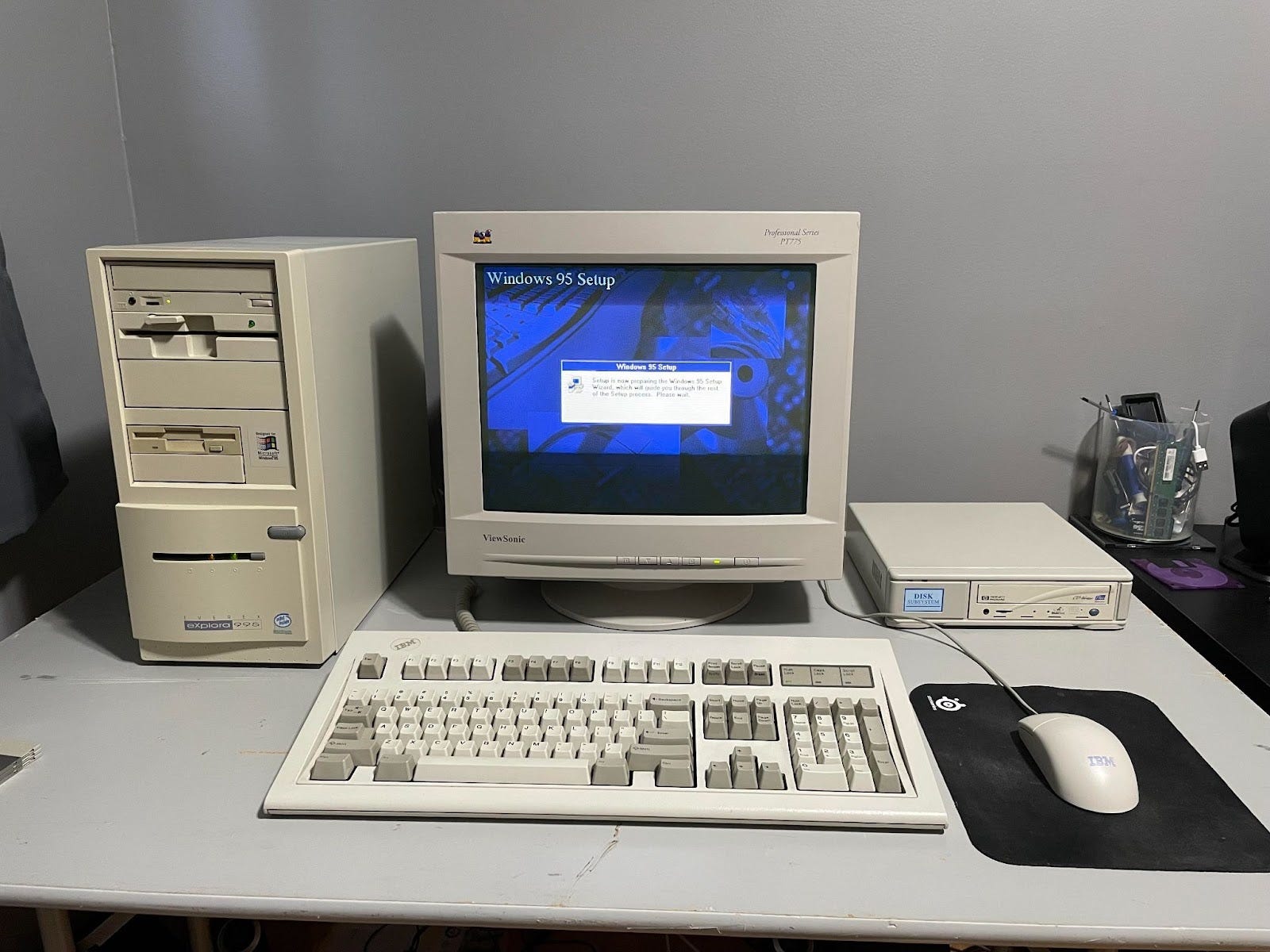
He cut his teeth programming on it, spending hours downloading JDK 1.0 over a 36k modem. Growing up in the nineties, he was drawn to the open-source movement — not just the technology but what it represented. The idea that the internet could democratise access to information and reshape society felt radical at the time, though much of it has since played out. One question in particular stayed with him: what if a computer could program itself?
This question drove his studies forward, and he undertook Computer Science at the University of Kent.
College and Graduation
At Kent, Nick was an early pioneer in Machine Learning, especially “naturally-inspired algorithms.” Nick spent a great deal of time exploring particle swarms, meta-heuristics, and optimisation applied to machine learning during his university days, and was particularly interested in their application. During his PhD, he was introduced to more nuanced topics, including early Deep Learning, CUDA, and distributed systems, and applied his knowledge to Bioinformatics, predicting protein functions.
Graduating into the Great Financial Crisis was difficult; AI and machine learning were still confined to very niche applications, but Nick found quick work with a few cutting-edge software companies, including an early continuous glucose-monitoring company. Later, before taking a position at one of the world’s oldest hedge funds, GLC.
GLC, JPM, AXA, Banqora
From GLC, Nick was hired by JP Morgan’s development team, excelling as a go-to developer for turning an intricate system of spreadsheets into a fully formed platform, and after 3 years of working under great bosses, he was promoted to Vice President and moved to front office rates, demonstrating his ability to lead and manage large teams in complex business settings.
After JPM, Nick was recruited by AXA Investment Management to lead a project modernising tooling under the new direction of Lauren Caillot. At AXA, Nick built a team and internal platform to optimize securities and trading operations. After delving into the nascent generative AI technology of 2023, and after discussions with his former colleague at AXA-IM, Ernst Dolce. Nick decided that AI technology had finally matured enough to revolutionize the industry and left to become CTO and founder at Banqora.
Banqora is the realisation of a question Nick has carried since childhood: what if a computer could program itself? The company applies that thinking to securities and trading workflows across Repo and Securities Lending — building dynamic, adaptive solutions that integrate directly into the daily reality of traders and portfolio managers rather than sitting alongside it.
Nick’s conviction is that Generative AI, and specifically agentic AI, will prove essential in augmenting human decision-making in real-time, high-stakes environments where the cost of poor judgment is measured in millions. His thesis — that AI would evolve beyond chat interfaces into an autonomous layer capable of orchestrating tools, delegating tasks, and operating across entire workflows — is now playing out before us. The major AI labs are shipping exactly this kind of agentic operating system, which Nick described as the intelligence layer in his publications.
At Banqora, Nick continues to build towards that future: technology that doesn’t just inform decisions but actively makes people better at making them.